
One Day at a Time
Updated: 2 days ago
Appeared in 2026 Fall Ranch Record. Story by Bob Welch.
Arlon Baize earns the RHA’s Working Cowboy Award-East.

If you were to create the ultimate day-working cowboy, a cotton farm in Tuxedo, Texas, probably wouldn’t be the place to start.
For Arlon Baize, however, those humble beginnings transformed him from chopping cotton to punching cows. He has spent more than 60 years making his living a-horseback, one day at a time, culminating in his recognition as the Ranching Heritage Association’s 2026 Working Cowboy Award Winner-East. Established in 2018, the Working Cowboy Award exists to recognize outstanding men and women who make their living in the saddle, taking care of livestock and the land on a daily basis. That description fits Arlon Baize to a “T.”
He was born in 1941 to Novel and Vida Baize, “I had the greatest mother in the world, and I mean that from the heart,” he says. Arlon was the second of three boys: Paige leading the way and Wayne completing the trio.
“I was born at Stamford in October and I tell everybody that was a pretty bad year for the United States,” he says. “I came in October and the Japanese came in December. All I knew my formative years was cotton and war.”
The boys learned the ins and outs of cotton farming, and worked like men to help their father bring in the crop. The one break he allowed them every summer was a trip to Stamford for the Texas Cowboy Reunion.
“In the summertime, that was the only thing we had,” Baize remembers. “We looked forward to it. It was something else back then.”
The inspiration was undeniable. From an early age, all Arlon Baize wanted to be was a cowboy.
“My first horse was my mother’s broom,” he says. “And my second horse was a chopping hoe.”
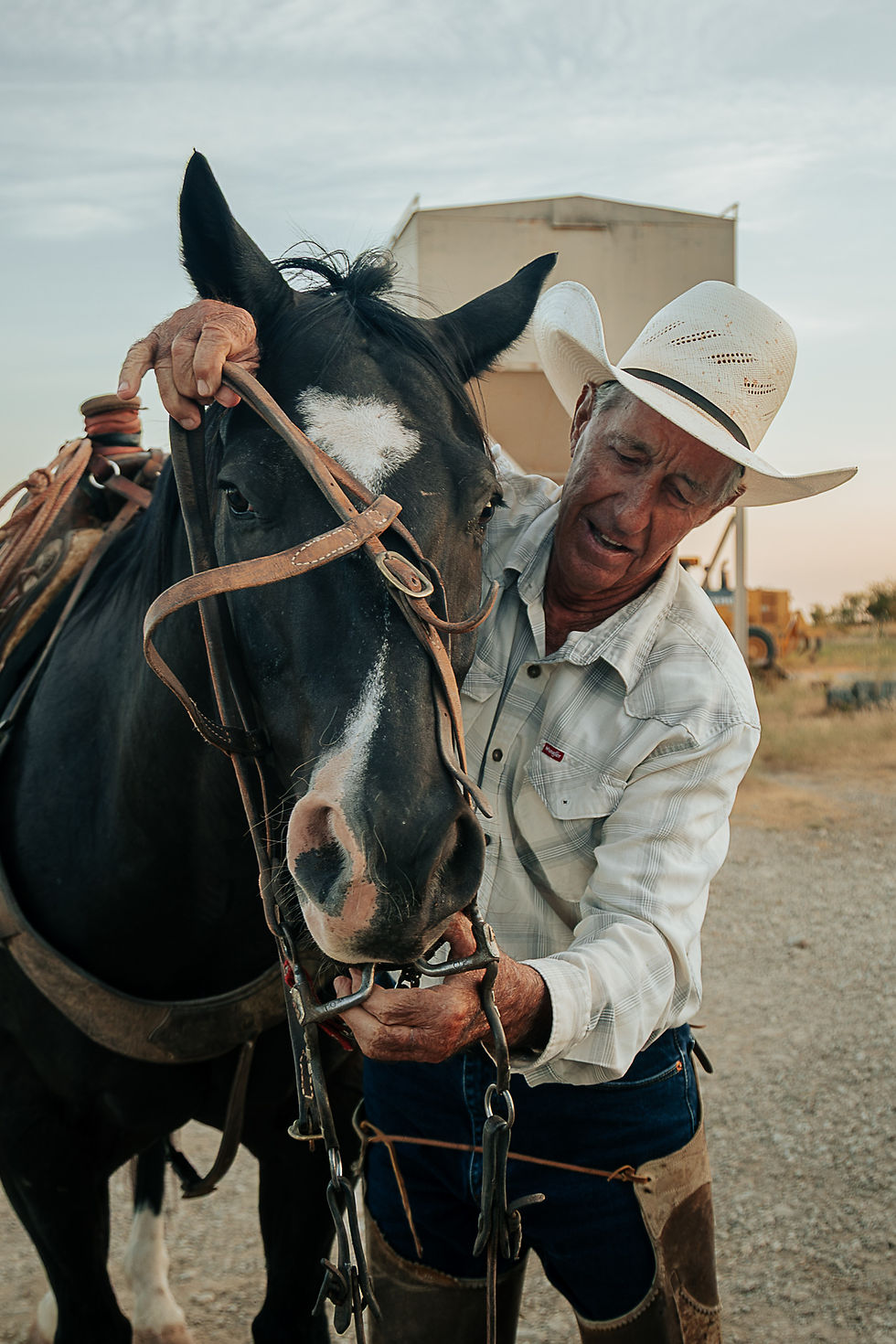
Little brother, Wayne, doesn’t remember the family ever bringing in a good crop of cotton. The Baizes diversified and incorporated some stock into the operation and had horses, but the boys were still a long row of cotton away from their dreams of cowboying. The drought of the 1950s finally forced Novel and Vida to sell out and move the family south of Abilene to Potosi where Arlon finished school.
Paige caught on as a cowboy with a rancher named Harry Holt and got married. Meanwhile, the farm at Potosi—being just seven miles south of Abilene—became more valuable and Novel and Vida sold it for development and moved to 400 acres of grassland near Baird. They had cattle and horses, but Arlon needed to find real work. He worked building fence, spent a couple years in a lumberyard in Abilene and was part of the labor crew that built Abilene’s first coliseum. But the cowboy itch hadn’t gone away.
For 50-plus years Arlon never took a full-time job on a ranch or in town. He’s kept a few personal cows around and bred some fine horses, but always paid the bills working on day-by-day handshake agreements.
“I really enjoyed it,” he says of getting his start as a day working cowboy. “You could just do the best you could and then come home and not have to worry about fixing water gaps or whatever. I guess it kind of spoils you.”
Some of the ranches and individuals Baize has worked for in his career include Harry Holt, Sears Ranch, Fall Ranch, Owens Ranch, Bob Gibson, Pruets, Guitars, Grissom Ranch, Spade Ranches, Caldwells, Montgomerys, Buster Welch, Hemphills, Snyders, Green Land and Cattle. Stasny, Elliott, Beckham, Windham, Scott, Akers and Matadors. He jokes that he’s been in every pasture within a 40-mile radius of Baird.
“I got to work with a lot of good cowboys here and there and everywhere,” Baize says, mentioning just a few names such as Tommy Smith, J.R. Edwards and Bob Bird. “They inspired me to be as good as I could. The ones I admired were the ones that could do all things.”
Now it’s Baize who is the legendary hand at any works he’s hired out to help—which he still does.
“I’ve been around him for 30 to 40 years,” says Jimbo Humphreys, former WCA Winner and longtime manager and camp man for the Guitar Ranches. “Since I went to work for Guitars 30 years ago, I’ve been around him. He’s the epitome of those old men I was raised around 50 years ago. He just tends to his business. He’s real quiet and humble without a whole lot to say, but pretty quick-witted in a humorous way. He was still flanking calves at 70 years old and never complained about it.

“He’s a really good stockman. He could read cattle and that’s what made a good hand. He was raised with a great work ethic. He didn’t come to the works with a trailer load of horses. He had a couple of really tough horses and always rode them barefooted.”
Working cattle, of course, requires a good horse and Baize had a keen eye for horseflesh right from the start of his career. In the 1970s his younger brother, Wayne, was an aspiring artist, working on paintings on the Four Sixes and Arlon convinced him to ask the manager, Mr. George Humphreys, about buying a colt. He found them an orphaned filly—a Double Devil out of a Three Bars mare—and sold it to the brothers cheap.
“I finally got to getting my own horses riding and took a lot of pride in it,” Arlon says. “Wayne and I partnered up and started breeding horses. We got the filly from the Four Sixes in 1970. Then we got an owned daughter of Grey Badger from the Triangles.”
Before long they were pleased enough with their mares that they took one to Doc Olena. Later, they bought a share of Doc’s Buddha.
“I was kind of the silent partner,” Wayne says. “I kept silent because I didn’t know anything about it. He knew them, and he knew the bloodlines, and he knew the people. We raised some good colts and sold some good colts. Bred them to the right horses and stuff.”
At the moment, Arlon has three young horses by a Metallic Cat stud that he owned until recently.
“I got a 2-year-old colt I’m training and two yearlings,” Arlon says. “I’m still not over it. Tommy Smith told me, ‘You make a good horse between sundown and dark.’”
In his 50-plus year career as a working cowboy, he’s seen his fair share of changes. The biggest change—he still maintains— is the introduction of the gooseneck trailer. Cowboys could now haul to whatever pasture they were working—and that also ushered in the era of day workers using their own horses versus company horses. There are other surprising differences, as well.

“To tell you the honest truth, I worked until I was probably in 30 years old before I ever saw anybody drag a calf to the fire,” Baize says. “Because up in that country they had a shortage of labor during the war and everyone got to using those calf cradles. Talking about changes, these young cowboys nowadays, I’ll declare they’re so ahead in every way. They’re doing things right now that I never could do. They take pride in their horses and they’re making a hand. They want to be rooting tooting cowboys and I give that credit to the Western Heritage.”
Baize claims that the events like the Western Heritage Classic in Abilene, one of the first professionally produced ranch rodeos, raised the bar for aspiring cowboys. And Baize left his mark on the WHC, riding for several teams and winning it twice with Guitar Ranches.
“Arlon Baize. There’s not a cowboy in the Abilene area who doesn’t recognize that name. He is a legend and everybody loves him,” says Craig Pruet, one of Baize’s longtime clients. “Arlon spent his life as a day working cowboy. He helped them all on their hardest days.”
And he’s still not done—he turns 85 on the day he receives his Working Cowboy Award. After that, though, he’ll be helping on the fall works all around Abilene and those colts won’t start themselves.


Comments